

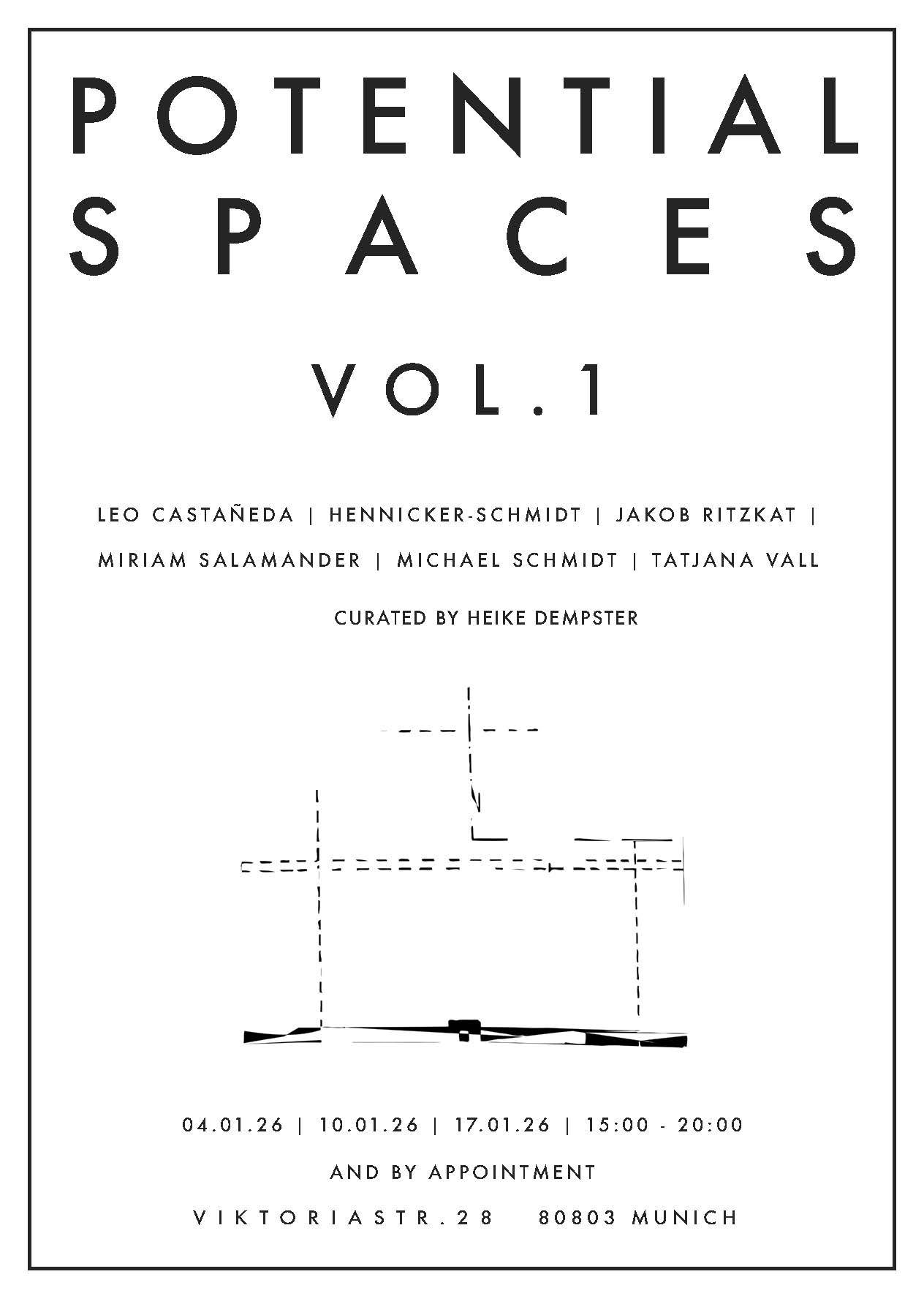
Potential Spaces Vol. 1 mit Leo Castaneda, Hennicler-Schmidt, Jakob Ritzkat, Miriam Salamander, Michael Schmidt, Tatjana Vall
04.01.26 – 17.01.26Öffnungszeiten:
4.01. , 10.01, 17.01. je 15:00 – 20:00h , sowie nach Vereinbarung
Kuration:
Heike Dempster
Teilnehmende Künstler*Innen:
Leo Castaneda, Hennicler-Schmidt, Jakob Ritzkat, Miriam Salamander, Michael Schmidt, Tatjana Vall
Potential Spaces Vol. 1 unfolds across a sequence of rooms that are never simply defined by architectural considerations, but rather are sites in which meaning, memory, and imagination coalesce. Each participating artist begins by engaging with an individual room on the lower floor. Here, a first level of dialogue emerges: between the work and the given architecture, between the physical traces of the space and the conceptual or material vocabulary the artists introduce. As visitors move between these rooms, a second dialogue forms—one generated not by static objects, but by the transitions, contradictions, and resonances that appear in motion. The exhibition culminates in the upper level, where all artistic positions converge in a shared third space that offers room for encounters, negotiation, and potential meanings that are yet to emerge.
The exhibition adopts an understanding of space not as fixed volume, but as a mutable zone shaped by layers, perspectives, and the psychic and cultural histories we project onto it. Like ephemeral architecture, each room exists only temporarily in its current constellation; its reference points shift as artworks alter sightlines, disrupt boundaries, or dissolve the original architecture altogether. Spaces—real or imagined—are always in flux. They carry traces of use, memory, and desire, and they continually oscillate between the heimlich and the unheimlich, between familiarity and estrangement.
The artists draw from vocabularies of architecture, landscape, and urban structures, transforming them into interior languages. Points, lines, thresholds, openings, and surfaces become carriers of psychological tension and sites of association. Through layering, fragmentation, and material transformation—whether in photographic collage, spatial intervention, video installation or the gradual formation of handmade paper—space is not only represented but generated. Surfaces become volumes; volumes become maps of inner states. As in dream-work, incompatible perspectives coexist, merge, or reconfigure one another, revealing new symbolic and affective meanings.
This exhibition approaches space as a vessel for knowledge, identity, and cultural memory. It echoes Winnicott’s concept of potential space—the realm between inner and outer world where play, creativity, and transformation occur. Here, visitors are invited to inhabit this in-between zone, questioning how places shape us, how we inhabit them, and how architectural structures inform our sense of self. Potential Spaces Vol. 1 thus proposes a speculative field in which physical, psychic, and social dimensions of space intertwine, opening a terrain for reflection, re-imagination, and new forms of encounter.
Ort:
Viktoriastr. 28, 80803 München
potential_spaces_vol_1
20.03.26 – 29.03.26
BitterSüß – Bilder und Skulpturen von Mensch und Tier – Ragna Zeit-Wolfrum
07.03.26 – 17.04.26
Abstrakte Fotokunst in Verbindung mit handbearbeitetem Stahl, Messing und Kupfer, Kathrin Sachse
01.03.26 – 26.04.26
The Matter of Shadows – Julia Schewalie, StKK – Stiftung für Konkrete Kunst Roland Phleps
01.03.26 – 03.04.26
RESONANCE – Anja Verbeek von Loewis, Hunsrück-Museum
11.02.26 – 21.03.26
ÜBERGANG – KATHARINA SCHELLENBERGER, Galerieverein Landsberg am Lech
22.01.26 – 22.03.26
Epistemische Räume – Tanja Fender – Galerie im Schlosspavillon
09.11.25 – 17.05.26
The Rise and The Fall (of the Great) – Gabi Blum im Fleischermuseum Böblingen